Everyday causal inference
How to estimate, test, and explain impacts with R and Python
A/B Testing, Causal Inference, Causal Time Series Analysis, Data Science, Difference-in-Differences, Directed Acyclic Graphs, Econometrics, Impact Evaluation, Instrumental Variables, Heterogeneous Treatment Effects, Potential Outcomes, Power Analysis, Sample Size Calculation, Python and R Programming, Randomized Experiments, Regression Discontinuity, Treatment Effects
Why this book?
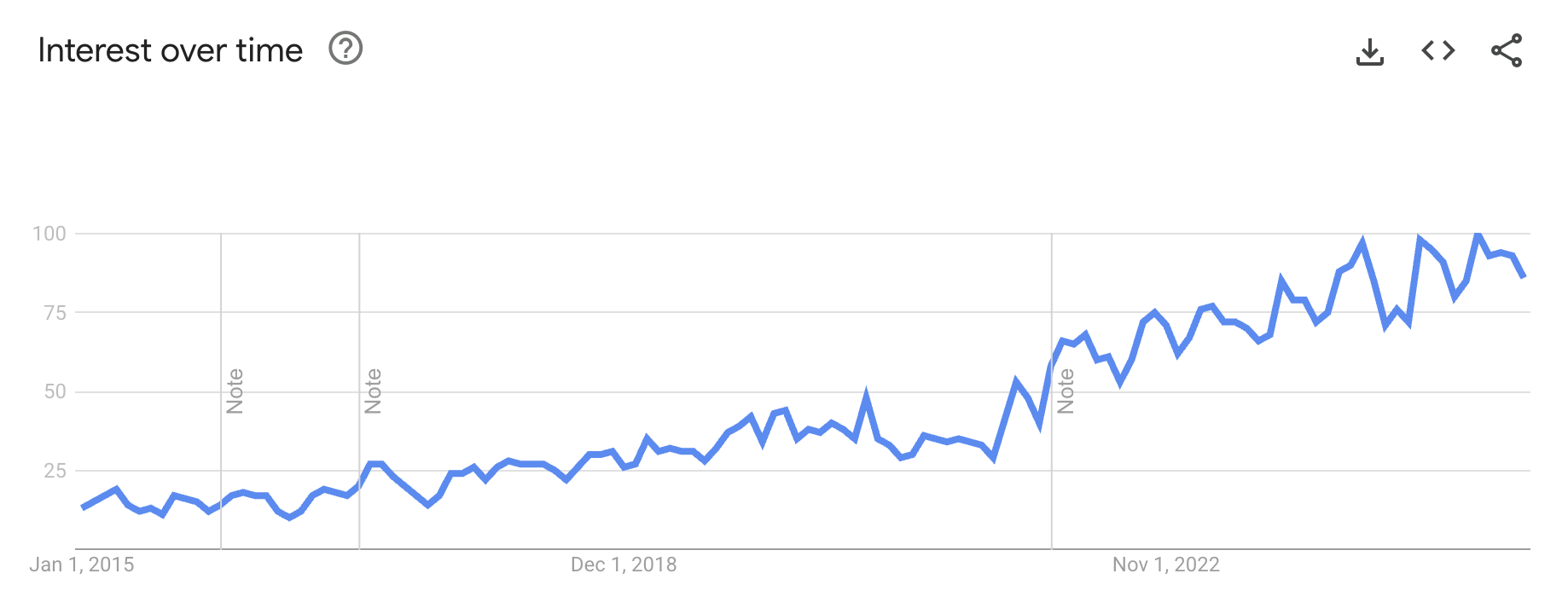
Searches for causal inference — the science of cause and effect — have been rising for over a decade. This is no coincidence. The questions that really matter for business and society are fundamentally causal. Think about it: Did this policy reduce inequality? Did that campaign actually increase sales? Did the new user experience (UX) improve retention?
But there is a gap. While the questions are causal, the decision-makers answering them often aren’t equipped to do so. Yet, in every meeting, someone will make a causal claim. They will look at a chart or a dashboard and weave a story of cause and effect. You need to be prepared for that moment. You need the tools to confidently trust a solid story—or to rightfully push back and demand evidence when the story falls apart.
The good news is that causal inference isn’t just for those fluent in advanced statistics or code. The real game-changer isn’t technical skill; it’s the way you reason. It is about knowing what questions to ask, understanding what the evidence actually shows (and what it doesn’t), and identifying what might be distorting your results. That is critical thinking, not just formulas. This book is designed to give you that reasoning.
I will cover the core methods—experiments, statistical power, instrumental variables, regression discontinuity, and difference-in-differences. But we won’t get lost in the math. Instead, we’ll keep one foot in rigor and the other firmly in practice.
The core philosophy here is simple, inspired by Richard Feynman: “Everything that I read I try to figure out what it really means, what it’s really saying by translating.” I take that literally. This book is a relentless exercise in translation. I strip away the jargon to reveal the plain logic underneath. I turn complex assumptions into intuition you can actually use.
Think of it as a street-smart survival guide. Most resources teach you how to get a result. I teach you how to survive the questions that follow. You will learn to:
- Decode the fine print, translating abstract assumptions into checkable facts about your business reality.
- Stress-test your work, catching flaws in your analysis before your stakeholders do.
- Bridge the gap, converting statistical findings into the language of decision-makers.
Ultimately, this isn’t just about running models — it’s about understanding them deeply enough to know when they work, when they don’t, and why it matters.
Yes, this book is for you
This book is for the builders and the decision-makers. It is for anyone who needs to make high-stakes decisions based on data and wants to do it with confidence.
The examples you’ll see are grounded in the world of digital business — e-commerce, tech, and online platforms. Why? Because these are environments where data is abundant and decisions happen fast. But don’t let that fool you. The logic of causality is universal.
The exact same tool that measures the impact of a website redesign is used to evaluate a new public health policy or an educational program. The variables change, but the reasoning does not.
So, whether you are a data scientist tired of unreadable papers, a product manager looking for truth, or a researcher wanting to apply your skills in the wild, you are on the right path for clarity. I trade dense proofs for intuition and abstract formulas for analogies. There are plenty of textbooks that will teach you the math. This one teaches you the craft.
How to support this project
If you find this book useful, here is how you can help:
Share it: Post on LinkedIn, X, or send it directly to your team. Traffic helps it show impact.
Star it: Give the GitHub repository a star. It signals genuine interest to publishers.
Cite it: Tigre, Robson. Everyday causal inference: How to estimate, test, and explain impacts with R and Python.
Buy it: Search for the print version when it is available. Your purchase directly supports this work.
Acknowledgements
This book wouldn’t have been possible without the encouragement, feedback, and support of many people. So thanks to everyone who helped bring this project to life.
First, I want to thank my wife, Cristiane Cabral, for being my number one supporter. I must also thank the following people who provided feedback, ideas, and encouragement for this book: Ron Kohavi, Peter Hull, Nick Huntington-Klein, Scott Cunningham, Matheus Facure, Andre Yukio, Fernanda Maciel, Isaac Gerber, Hugo Gobato, Kay H. Brodersen, Max H. Farrell, Fiammetta Menchetti, Bruno Moura, Vanessa Barreiros, Raphael Bruce, Cleyton Farias, Ana Santos, Junia Barbosa, Luis Meloni.